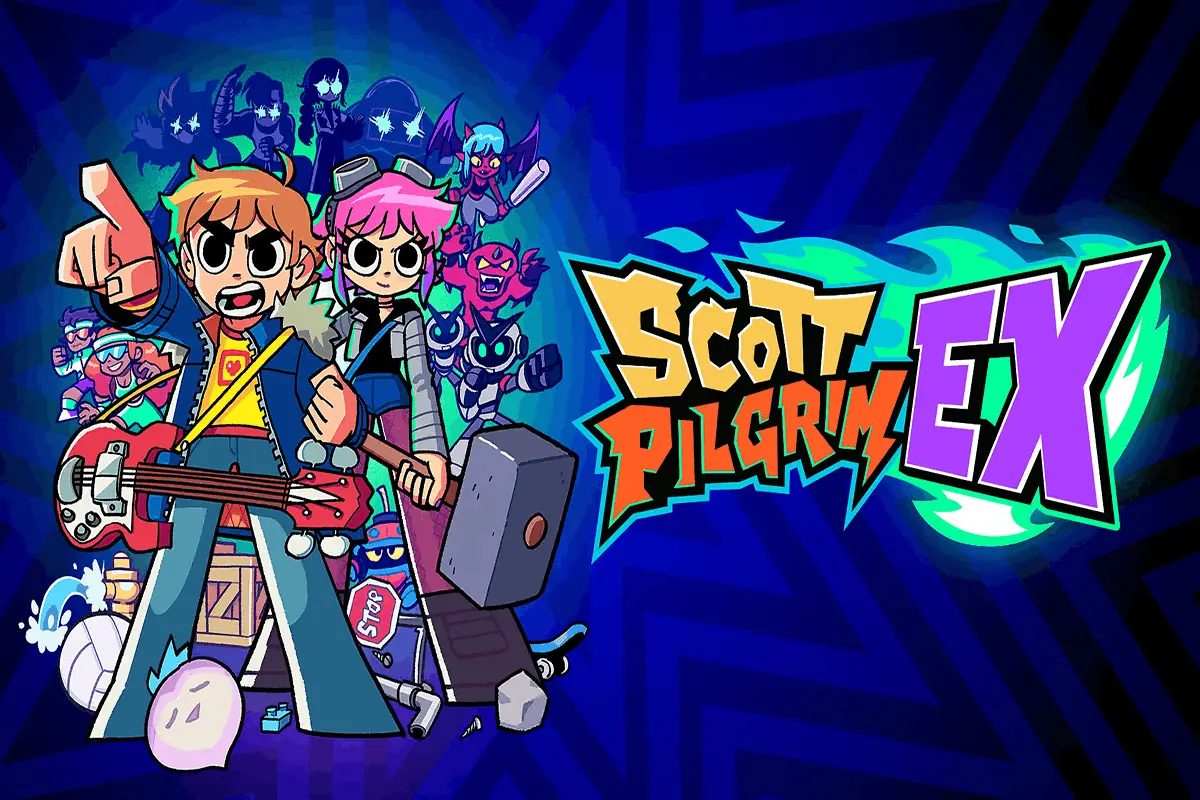
A Stylish, Chaotic Beat ’Em Up Packed With Nostalgia
Introduction
Scott Pilgrim EX is a brand-new action-adventure beat ’em up that brings Bryan Lee O’Malley’s beloved universe back to video games with a completely original story. Developed by Tribute Games, the studio behind Teenage Mutant Ninja Turtles: Shredder’s Revenge, the game builds on the foundation of the earlier Scott Pilgrim vs. The World: The Game while introducing a larger interconnected version of Toronto, new enemies, new gameplay systems, additional playable characters, and a progression system that gives the classic brawler formula considerably more depth.
The story begins in Toronto in the familiar 20XX era, but this time the city has been thrown into complete chaos. Scott Pilgrim’s bandmates are mysteriously kidnapped before an important performance, while three rival factions—demons, robots, and vegans—take control of different parts of the city. Strange dimensional rifts begin appearing throughout Toronto, connecting the characters to bizarre locations that seem to exist outside normal time and space. Scott, Ramona Flowers, and several unlikely allies must travel through these distorted areas, defeat increasingly strange enemies, and discover who is responsible for the crisis.
Rather than retelling the original comic or movie storyline, Scott Pilgrim EX tells a new adventure created in collaboration with series creator Bryan Lee O’Malley. The game also embraces the franchise’s long-standing relationship with video-game culture. Its pixel-art presentation, exaggerated combat, absurd bosses, humorous dialogue, retro references, and energetic music make it feel like a natural extension of the Scott Pilgrim universe.
The result is an entertaining and polished brawler that understands exactly why the franchise has such a loyal following. However, the decision to place the traditional beat ’em up inside a semi-open city introduces some pacing and backtracking problems that prevent the game from being as consistently excellent as its combat and presentation suggest.
Scott Pilgrim EX Gameplay
At its core, Scott Pilgrim EX remains a side-scrolling beat ’em up, but Tribute Games has expanded the formula considerably. Players move through interconnected sections of Toronto, fighting gangs, completing objectives, discovering hidden areas, purchasing upgrades, collecting money, and unlocking additional abilities. Instead of simply progressing from one linear stage to another, the city functions as a central hub from which different missions and dimensional rifts can be accessed.
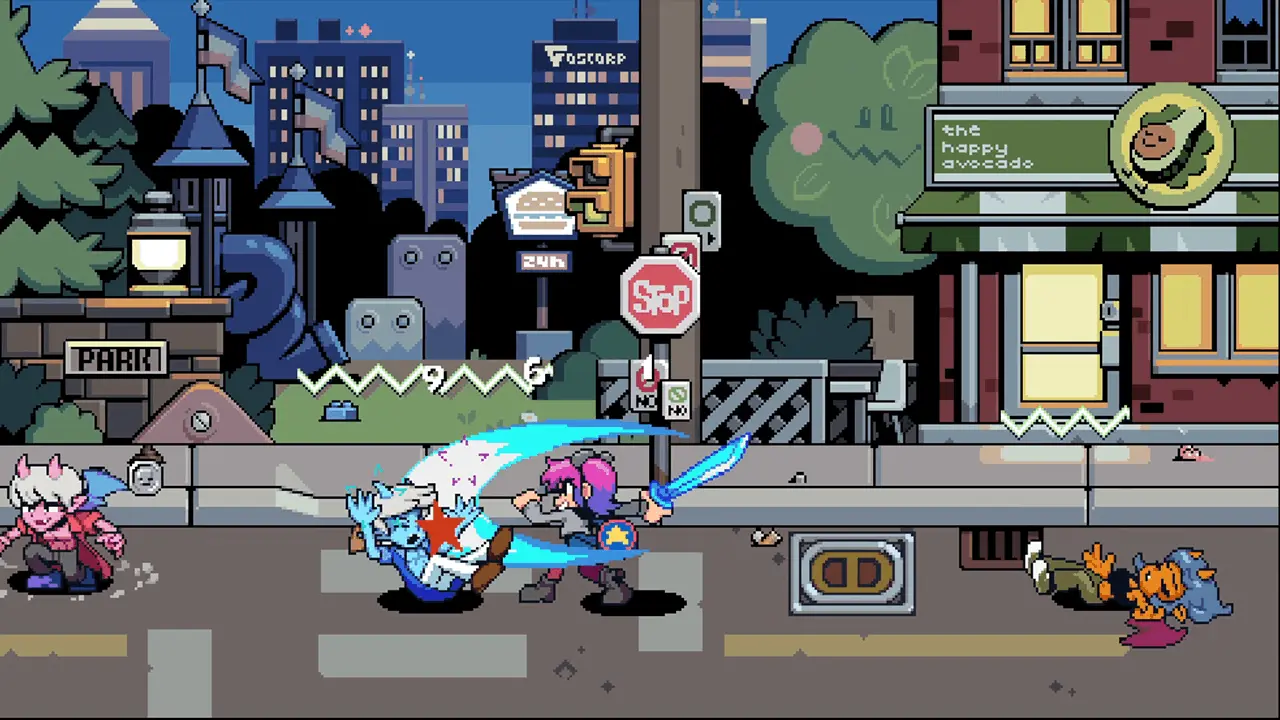
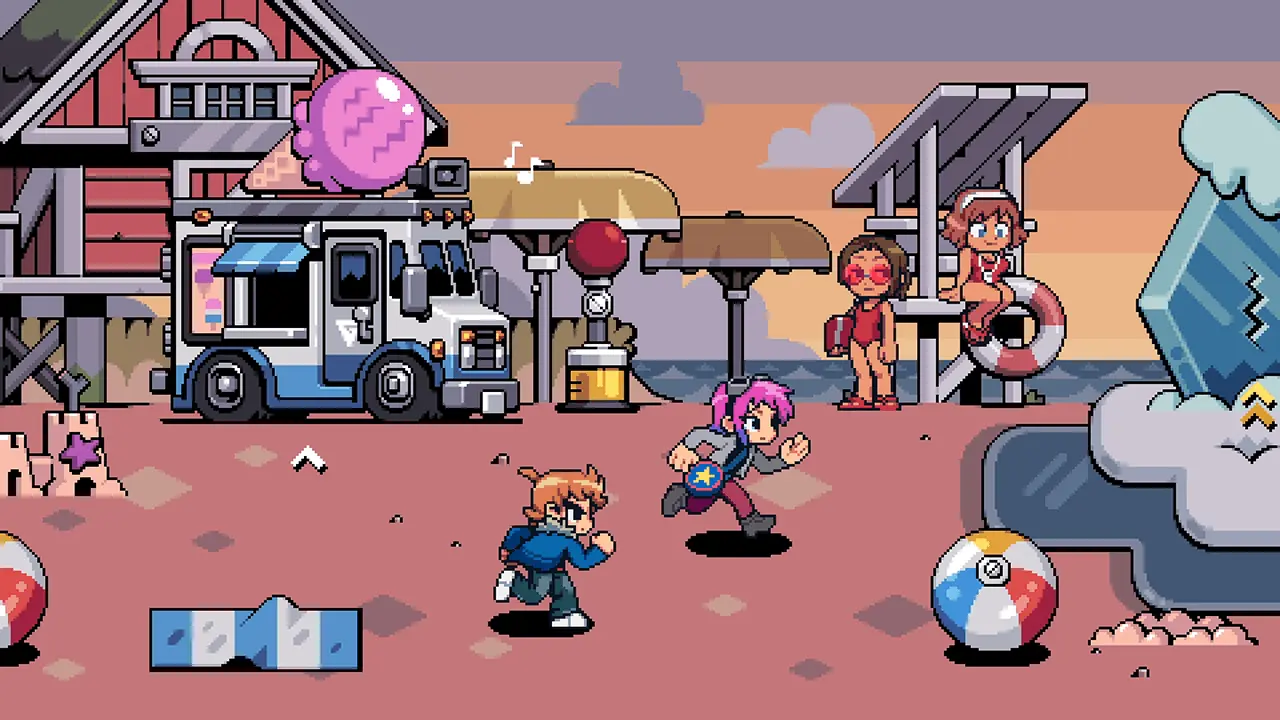
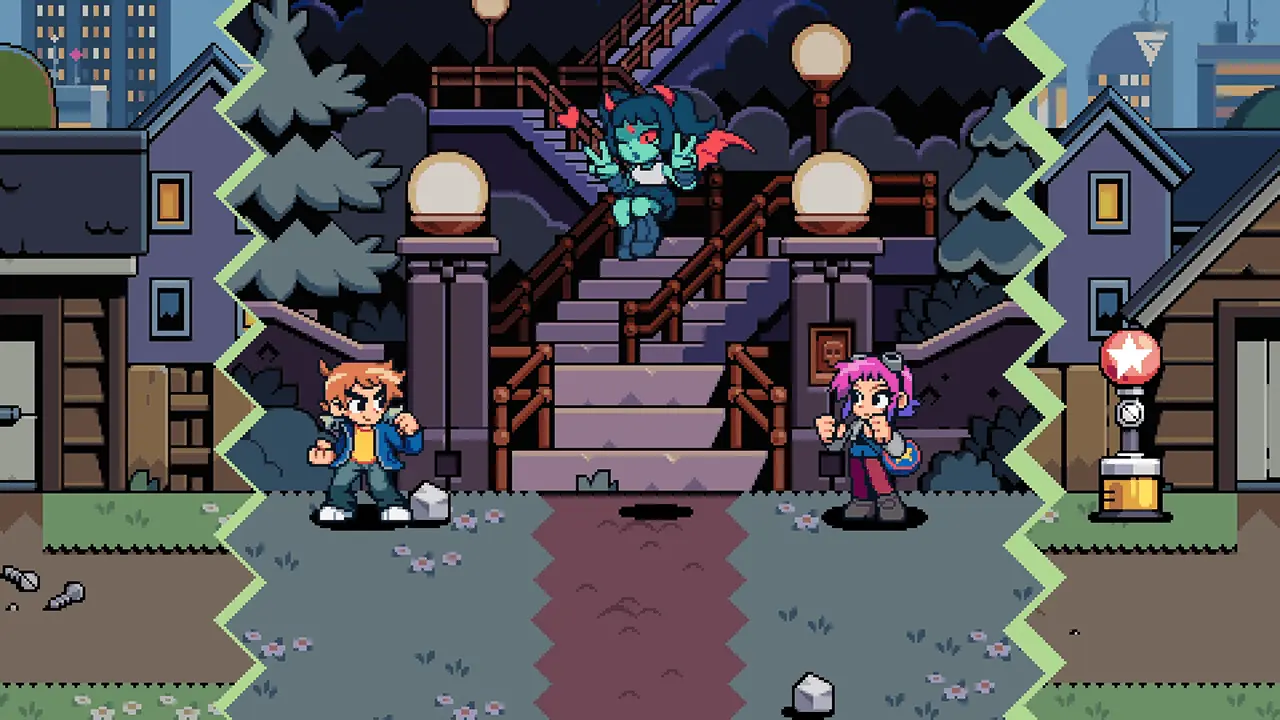
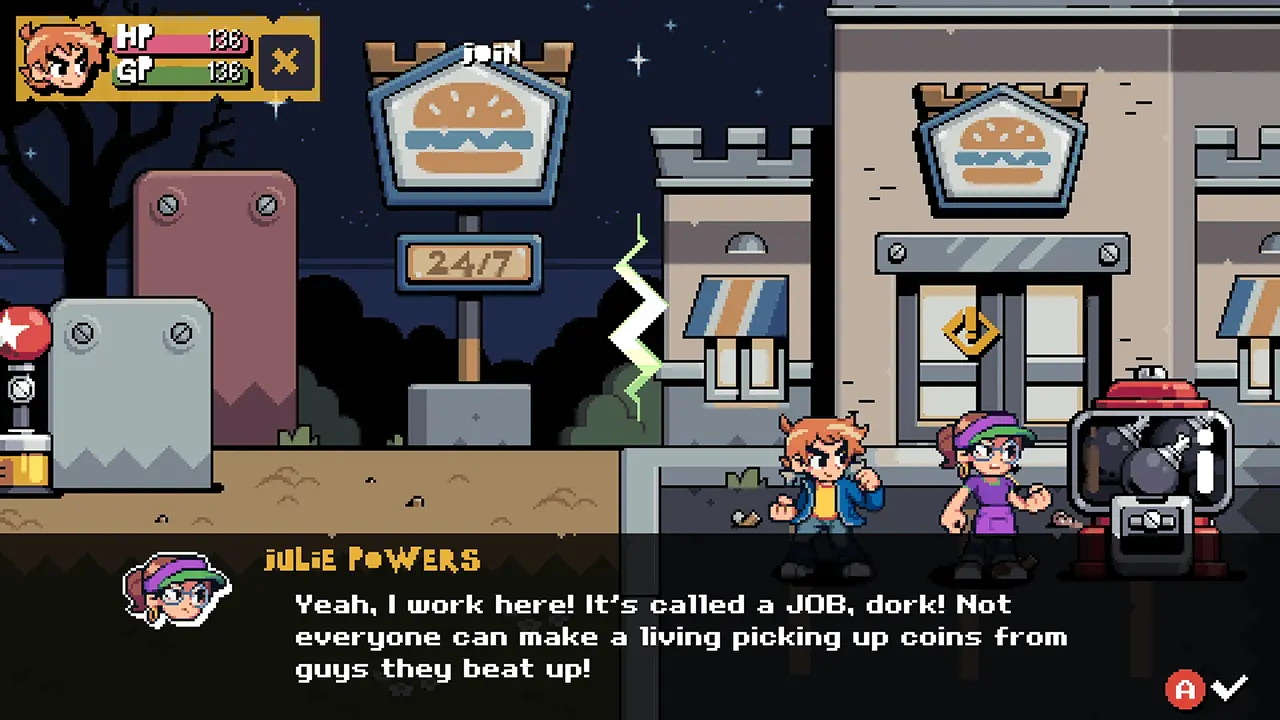
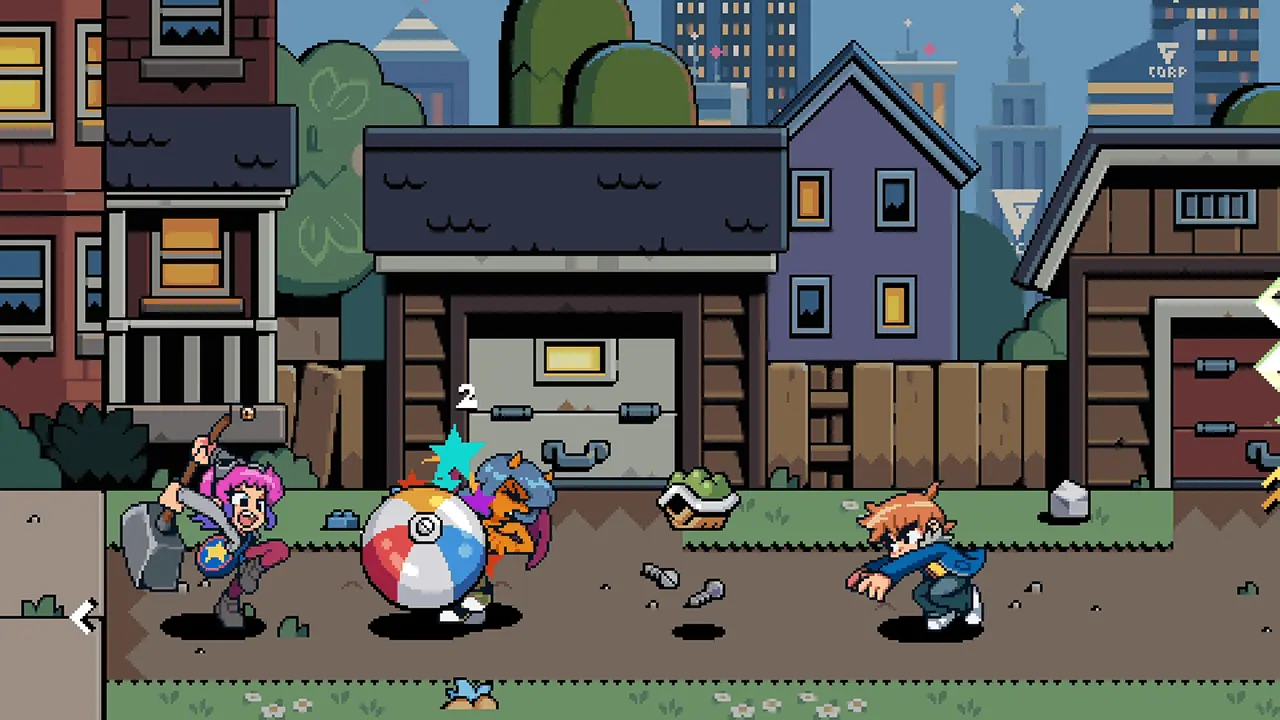
The combat system is immediately accessible but has enough depth for experienced players to experiment with more complicated combinations. Characters can punch, kick, jump, block, throw objects, perform special attacks, juggle enemies, and use environmental objects as weapons. Crowd control becomes especially important because enemies can attack from multiple directions, forcing players to combine movement, attacks, throws, and defensive positioning rather than simply hitting whatever enemy is directly in front of them.
One of the game’s biggest improvements is how much more distinctive the playable characters feel. The original seven-character roster consists of Scott Pilgrim, Ramona Flowers, Matthew Patel, Gideon Graves, Lucas Lee, Roxie Richter, and Robot-01. Each has a different combat identity, animations, statistics, and special attacks, meaning that changing characters can significantly alter the way a level is approached.
Scott is the most balanced fighter of the group and works particularly well for newcomers. His moveset combines strong punches and kicks with a variety of attacks that make him effective against both individual enemies and crowds. Ramona is more closely associated with her enormous hammer, giving her attacks considerable personality and impact. Matthew Patel brings supernatural abilities into combat, using demonic powers and theatrical attacks that distinguish him from the more conventional fighters.
Gideon Graves offers another unusual interpretation of the franchise’s villain, while Lucas Lee uses his enormous physical strength and skating-inspired fighting style to create a heavier, more straightforward approach to combat. Roxie Richter brings a faster and more aggressive style, with her sword making her attacks visually distinct. Robot-01 is the most deliberately over-the-top character, delivering huge attacks that fit his exaggerated anime-inspired personality.
The game also received additional playable characters through the Back in the Band DLC. Stephen Stills, Kim Pine, and Knives Chau expand the roster and reunite the core Sex Bob-Omb lineup. Tribute Games designed these characters around their personalities rather than treating them as simple cosmetic additions. Knives, for example, is built around speed, mobility, rapid knife attacks, and her scarf, giving her a fast hit-and-run fighting style.
Character progression adds another layer to the brawling. Players earn money from enemies and activities, then spend it on food, equipment, accessories, and upgrades. Characters can increase their statistics and equip special items that provide additional bonuses. Assist abilities can also be customized, allowing players to adjust their preferred combat style instead of simply relying on each character’s default configuration.
The mission structure is considerably different from the previous Scott Pilgrim game. The main campaign contains roughly a dozen major objectives, supported by smaller challenges and optional activities. Missions frequently involve traveling through Toronto, locating specific objects, rescuing characters, opening dimensional pathways, fighting bosses, or collecting items required to continue. Some areas also contain timed challenges and hidden activities that reward players with money or upgrades.
The dimensional rifts are one of the game’s most creative features. They transport the characters into wildly different environments, allowing Tribute Games to move beyond ordinary Toronto streets. Players can encounter gothic locations, beaches, medieval-themed areas, strange laboratories, burger-themed environments, and other deliberately ridiculous settings. These locations culminate in unusual boss encounters that frequently turn the franchise’s humor and video-game references up to eleven.
Exploration also reveals secrets. Hidden quests, treasure chests, combat challenges, NPC interactions, and optional training activities encourage players to investigate areas instead of simply following the main objective marker. Some secrets even reward players with useful upgrades or additional money, making exploration worthwhile.
The biggest weakness is the amount of backtracking. Because Toronto functions as a connected hub, several missions require players to revisit previously explored locations. What initially feels like freedom can eventually become repetitive, especially when the player is sent across the map to retrieve another object before returning to an earlier location. GamesRadar+ was particularly critical of this structure, arguing that too many objectives become fetch quests and that repeated trips across the map can interrupt the otherwise excellent rhythm of the combat.
Still, the combat itself remains the game’s strongest feature. Battles are fast, responsive, colorful, and satisfying, while the variety of character movesets encourages experimentation. The four-player cooperative system is especially effective because different characters can be combined to create chaotic but entertaining battles. Up to four players can join locally or online, with drop-in/drop-out support making multiplayer sessions easy to organize.
Story and Narrative
The story starts when Scott Pilgrim’s bandmates are abducted shortly before Sex Bob-Omb is supposed to perform. Their disappearance is only the beginning of a much larger problem because Toronto has been overrun by three bizarre factions: demons, robots, and vegans. Dimensional rifts are appearing throughout the city, connecting familiar locations with completely unexpected worlds.
Scott and Ramona set out to rescue their friends and recover the band’s missing instruments. Their search brings several former enemies into the group, including Matthew Patel, Gideon Graves, Lucas Lee, and Roxie Richter. The unusual team-up is one of the story’s most entertaining ideas because characters who previously represented obstacles to Scott are now fighting alongside him.
The investigation eventually reveals that the crisis is connected to G Corp and a strange alternate version of Scott. The presence of a metal Scott gives the story a deliberately ridiculous science-fiction angle while allowing Tribute Games to explore another version of the character without taking the narrative too seriously.
The story is intentionally lighter than the original Scott Pilgrim narrative. The comic and film dealt with emotional immaturity, relationships, insecurity, and personal growth beneath their exaggerated action-comedy surfaces. Scott Pilgrim EX is much more interested in having fun with the universe. Its plot exists primarily to move the characters between bizarre locations and increasingly ridiculous fights. This makes the game accessible to newcomers but also means returning fans looking for the emotional depth of the original may find the narrative comparatively shallow.
Graphics and Sound
The presentation is arguably the most consistently impressive aspect of Scott Pilgrim EX. The game uses detailed pixel art inspired by Bryan Lee O’Malley’s original visual style while adding fluid animation, elaborate effects, expressive character poses, and densely designed backgrounds. Artist Paul Robertson’s work gives the game an instantly recognizable appearance, with almost every screen containing small references, visual jokes, and details for fans to discover.
The character animations are particularly effective because each fighter communicates personality through movement. Lucas Lee’s physicality, Ramona’s enormous hammer, Robot-01’s exaggerated attacks, and Matthew Patel’s supernatural abilities all make the roster visually distinct.
There are occasional perspective problems, particularly in areas where platforming interacts with detailed backgrounds, but these moments are relatively minor compared with the overall quality of the artwork.
The soundtrack is another major highlight. Anamanaguchi returns with an entirely new collection of energetic music, blending chiptune sounds with punk, electronic influences, and catchy rock melodies. The music complements both the retro presentation and the chaotic action, while also providing a nostalgic connection to the earlier Scott Pilgrim game. Several reviewers identified the soundtrack as one of the game’s strongest elements.
Verdict
Scott Pilgrim EX is a polished, energetic, and extremely stylish beat ’em up that successfully expands upon the foundation established by the earlier game. Its combat is fluid and satisfying, the seven-character launch roster offers genuine variety, the pixel art is outstanding, and Anamanaguchi’s soundtrack gives almost every battle an infectious sense of momentum. The semi-open Toronto structure, progression system, hidden quests, and four-player multiplayer also make it feel considerably more ambitious than a straightforward arcade brawler. Its biggest problems are the repetitive backtracking, fetch-oriented objectives, relatively short campaign, and a story that lacks some of the emotional substance associated with the original Scott Pilgrim narrative.
The Good
- Excellent pixel-art animation and expressive character design.
- Fast, responsive, and satisfying beat ’em up combat.
- Seven distinctive launch characters with different fighting styles.
- Additional playable characters through the Back in the Band DLC.
- Excellent new soundtrack by Anamanaguchi.
- Four-player local and online cooperative gameplay.
- Interesting character progression, equipment, and stat customization.
- Numerous secrets, side challenges, hidden quests, and upgrades.
- Creative bosses and bizarre locations.
- Strong fan service without requiring complete knowledge of the franchise.
The Bad
- Repetitive backtracking can interrupt the pace.
- Many objectives rely heavily on fetch-quest design.
- Main campaign is relatively short.
- Story is lighter and less emotionally meaningful than the original Scott Pilgrim narrative.
- Some platforming sections can suffer from perspective confusion.
- Long-term replayability could have benefited from additional dedicated modes.
Release Date and Platforms
Scott Pilgrim EX launched in March 2026, with the main release date listed as March 3 on most platforms, while the Steam listing records March 2 depending on regional timing. The game is available on PlayStation 5, PlayStation 4, Xbox Series X|S, Xbox One, Nintendo Switch, Nintendo Switch 2, and PC. It supports single-player gameplay as well as local and online cooperative multiplayer for up to four players.
Genre
Scott Pilgrim EX is primarily a 2D action-adventure beat ’em up, but its design incorporates light action-RPG and exploration elements. The foundation is classic side-scrolling brawling, while the interconnected city, quests, character upgrades, equipment, shops, collectibles, and hidden activities make it more expansive than a traditional arcade-style beat ’em up. It sits comfortably alongside modern genre revivals such as River City Girls and Shredder’s Revenge, while using its Scott Pilgrim identity to introduce more personality and experimentation.
Developer and Publisher
Scott Pilgrim EX was developed by Tribute Games, the Montreal-based studio that has become closely associated with modern beat ’em ups. The developer previously created Teenage Mutant Ninja Turtles: Shredder’s Revenge and has built a reputation for combining traditional arcade mechanics with modern presentation and accessibility. Tribute Games also publishes Scott Pilgrim EX, while physical editions have involved publishing partners including Limited Run Games and iam8bit.
Scott Pilgrim EX System Requirements
Minimum
- Requires a 64-bit processor and operating system
- OS: Windows 10, 64-Bit
- Processor: Intel Core i3-2100 or AMD FX-4300
- Memory: 4 GB RAM
- Graphics: NVIDIA GeForce GT 320, 1 GB or AMD Radeon HD 5570, 1 GB or Intel HD 4600
- Storage: 1 GB available space
- Additional Notes: Requires a 64-bit processor and operating system
Recommended
- Requires a 64-bit processor and operating system
- OS: Windows 10, 64-bit
- Processor: Intel Core i5-2400 or AMD FX-6300
- Memory: 4 GB RAM
- Graphics: NVIDIA GeForce GTS 450, 1 GB or AMD Radeon R7 250, 1 GB or Intel HD 630
- Storage: 2 GB available space
- Additional Notes: Requires a 64-bit processor and operating system